

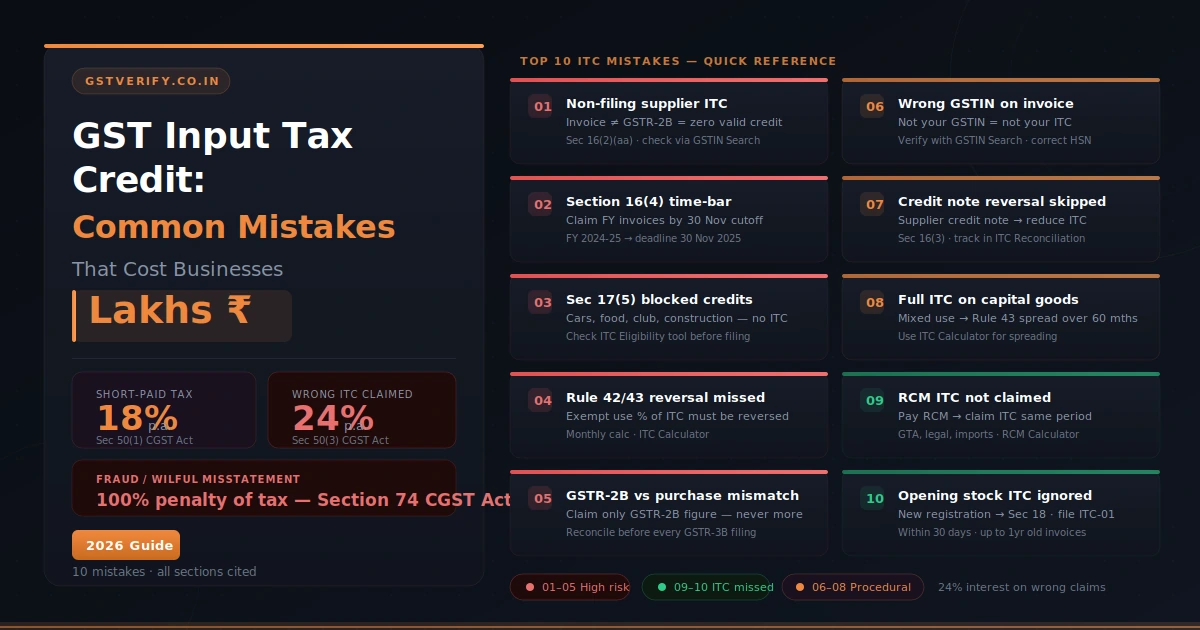
The most expensive GST ITC mistakes are not dramatic frauds — they are quiet, procedural errors that accumulate unnoticed across hundreds of invoices: claiming credit on a supplier who stopped filing returns six months ago, missing the Section 16(4) deadline by a single period, or reversing exactly the wrong proportion under Rule 42. The GSTN's automated scrutiny catches all of them. By the time a DRC-01 lands, the demand — interest included at 24% per annum on wrongful claims routinely runs into lakhs for even mid-sized businesses.
How ITC Works — A Quick Anchor
Input Tax Credit is the mechanism under Section 16 of the CGST Act, 2017, that allows registered businesses to deduct GST paid on purchases from the GST collected on sales. On paper, it is simple: output GST minus input GST equals what you pay. In practice, four conditions under Section 16(2) must be satisfied before any credit is valid:
- You hold a valid tax invoice or debit note from a registered supplier.
- You have received the goods or services (or both).
- The supplier has filed their GSTR-1 and paid the tax to the government.
- You have filed your own GSTR-3B for that period.
Fail any one of these — even temporarily — and the credit is ineligible or must be reversed. The GSTN's automated matching engine checks all four conditions simultaneously every time GSTR-2B is generated. That is why a supplier's non-compliance directly damages your ITC, even when you have done nothing wrong.
Use the ITC Eligibility checker before entering figures in GSTR-3B to confirm each major credit meets all four conditions.
Mistake 1 — Claiming ITC From a Non-Filing or Canceled Supplier
Why it happens: You receive a valid-looking invoice; the GSTIN on it is real, but the supplier filed GSTR-1 for a few months and then stopped filing. The invoice never appears in your GSTR-2B. You claim the ITC anyway, even though you rely on the physical invoice.
Why it costs you: Under the amended Section 16(2)(aa) of the CGST Act (effective January 2022, via the Finance Act 2021), ITC is available only to the extent that the supply appears in your GSTR-2B. A physically perfect invoice from a non-filing supplier generates zero valid ITC. When GSTN's auto-reconciliation flags the gap between your GSTR-3B claim and your GSTR-2B, an ASMT-10 notice follows — and you owe the wrongly-claimed amount plus 24% interest under Section 50(3).
The real cost: A manufacturer claiming ₹5 lakh of ITC monthly from three irregular suppliers over six months has ₹30 lakh of potentially invalid credits. With 24% interest and a 100% penalty for fraud or suppression (Section 74), the demand can reach ₹60 lakh+.
How to avoid it:
- Before accepting any vendor into your purchase order system, verify that their GSTIN is active and that they have a clean filing history using the GSTIN Search tool.
- For vendor lists of 20 or more, run a monthly Bulk GSTIN verification to flag inactive, suspended, or canceled GSTINs in a single pass.
- Add high-value vendors to your Watchlist to receive instant alerts if their status changes or they miss a filing.
- Never claim ITC that is absent from GSTR-2B, even if you hold the original invoice.
Mistake 2 — Claiming ITC Beyond the Section 16(4) Time Limit
Why it happens: A purchase invoice from April lands in July. The business processes it late and claims the ITC in the November GSTR-3B. This is now a time-barred claim.
The deadline rule: Under Section 16(4) of the CGST Act, ITC on invoices or debit notes for a financial year can only be claimed in the GSTR-3B filed on or before the earlier of:
- 30th November of the following financial year, or
- The date of filing the annual return (GSTR-9) for that year.
For FY 2024-25 invoices, the cut-off is 30 November 2025. Any ITC on FY 2024-25 invoices claimed in the December 2025 GSTR-3B is time-barred — even if the invoice is legitimate, the supplier filed properly, and the goods were received.
A nuance most businesses miss: The deadline applies to the financial year of the invoice, not the year of filing. An invoice dated 15 March 2025 must be claimed by 30 November 2025 at the latest — not November 2026.
How to avoid it:
- Maintain a purchase invoice aging report sorted by invoice date and ITC claim status.
- Run a Compliance Checklist review every October to identify any FY invoices still unclaimed before the November deadline.
- Instruct your accounts team that any invoice received after 1 October for the prior FY is at risk — fast-track processing.
Mistake 3 — Claiming Blocked Credits Under Section 17(5)
Why it happens: The GST paid on a business purchase should be recoverable. Often it is. But Section 17(5) of the CGST Act maintains a hard list of expenses where ITC is permanently denied, regardless of business purpose.
The blocked list every business must memorize:
| Expense Blocked? Exception | ||
| Motor vehicles (cars, SUVs) | Yes | If used for the transport of goods, passenger transport business, or driving training |
| Food, beverages, and outdoor catering | Yes | If you are in the food/catering business |
| Beauty treatment, health services, cosmetic surgery | Yes | If you run such a business |
| Membership of clubs, health/fitness centers | Yes | None |
| Travel benefits to employees (leave travel, home travel) | Yes | None |
| Works contract services for immovable property | Yes | If used for further supply of works contract services |
| Construction of immovable property | Yes | Plant and machinery are explicitly excluded from this block |
| Life insurance, health insurance for employees | Yes | If mandated by law (e.g., group medical insurance under labor law) — partially debated |
| Rent-a-cab | Yes | Unless mandatory under law or part of outward taxable supply |
The most expensive misclassification: Claiming ITC on the purchase of a company car (IGST ₹3.6 lakh on a ₹20 lakh car). GSTN flags this during annual return scrutiny — the demand is the full ₹3.6 lakh plus interest from the date of claim.
Use the ITC Eligibility checker to classify each expense type before booking the credit, especially for grey-area items such as business travel, employee wellness, and mixed-use vehicles.
Mistake 4 — Not Reversing ITC on Exempt and Non-Business Use (Rule 42/43)
Why it happens: A business that sells both taxable and exempt goods — say, a manufacturer of branded namkeens (5% GST) and roasted grams (nil GST) — claims full ITC on all raw material purchases. But inputs used for exempt supplies must have their ITC reversed proportionately under Rule 42 of the CGST Rules.
The formula (Rule 42):
ITC to reverse = (Total ITC on common inputs) × (Exempt turnover ÷ Total turnover)
Businesses routinely get this wrong in three ways:
- They simply forget to apply the formula.
- They apply it annually instead of monthly (Rule 42 requires a provisional monthly reversal with an annual true-up in GSTR-9).
- They use the wrong turnover figure — zero-rated supplies (exports) must be excluded from "exempt turnover" for this calculation.
Rule 43 applies the same logic to ITC on capital goods used partly for exempt supplies, spreading it over 60 months (five years).
Cost of non-reversal: If a business has ₹2 crore of annual ITC on common inputs and 30% of its turnover is exempt, the reversal due is ₹60 lakh/year. Failing to reverse this for two years = ₹1.2 crore demand + interest + penalty.
Calculate your exact monthly reversal obligation using the ITC Calculator, which handles both Rule 42 (inputs/services) and Rule 43 (capital goods) calculations with your actual turnover split.
Mistake 5 — Mismatch Between GSTR-2B and Purchase Register
Why it happens: The GSTR-2B is auto-generated on the 14th of each month. It reflects only invoices that suppliers have reported in their GSTR-1 before that date. Purchase invoices that arrive late, or suppliers who file GSTR-1 after the 14th, appear in next month's GSTR-2B — creating a permanent month-lag mismatch.
The three-way reconciliation businesses skip: Your GSTR-3B ITC claim should match (a) your purchase register, (b) your GSTR-2B, and (c) the vendor's GSTR-1 data. Most businesses check only (a) against (c) and miss the GSTR-2B column entirely.
Specific mismatches that attract notice:
- Claiming ₹10 lakh ITC in GSTR-3B when GSTR-2B shows only ₹8.5 lakh — automatic ASMT-10 trigger.
- GSTR-2B shows an invoice, but your purchase register doesn't — possible duplicate supplier filing, requires investigation.
- GSTR-2B shows a different IGST/CGST/SGST split than your invoice — cannot be claimed at face value; must match GSTR-2B exactly.
The fix: Reconcile the purchase register against GSTR-2B before filing every GSTR-3B — not after. The ITC Reconciliation tool auto-matches your purchase data against GSTR-2B, highlights line-by-line discrepancies, and tells you exactly how much is safe to claim this month versus deferred to next. Pair it with GSTR Reconciliation for a full inward-outward match before every filing date.
Mistake 6 — Claiming ITC on Invoices With Incorrect GSTIN or HSN
Why it happens: A supplier raises an invoice with your trading name's GSTIN instead of your legal entity's GSTIN, or enters the wrong HSN code. You book and claim the ITC without noticing.
Why it is invalid: ITC under Section 16(2)(a) requires a "valid tax invoice." An invoice with the wrong recipient GSTIN is technically not addressed to you — GSTN's matching engine will not link it to your GSTR-2B. An incorrect HSN code can lead to the wrong GST rate being applied, resulting in the tax charged — and therefore the ITC — being calculated on an incorrect basis.
The most common version: Multi-entity businesses where suppliers mix up GSTIN between related companies. The invoice is issued to Company A's GSTIN but is booked and claimed by Company B. Both companies are audited, and both face demands.
How to avoid it:
- Use the GST Invoice Generator for your own outward invoices — it validates GSTIN and HSN at the point of creation.
- For supplier invoices, verify that their GSTIN and your GSTIN are correct before booking using the GSTIN Search.
- Confirm correct HSN codes for each product category with the HSN Code Finder — and share the correct codes with regular suppliers to prevent recurring errors.
Mistake 7 — Missing ITC Reversal on Credit Notes Received
Why it happens: You receive a credit note from a supplier for a return, discount, or price revision. You adjust the payable amount in your accounts. Please reverse the ITC already claimed on the original invoice.
The legal position: Under Section 16(3) of the CGST Act, if you have claimed ITC on an invoice and subsequently receive a credit note from the supplier, you must reduce your ITC by the credit note amount in the month of receipt. Failing to do so results in an excess ITC balance, which GSTN identifies when your GSTR-2B for that period reflects the credit note (suppliers must report credit notes in GSTR-1).
The compounding version: A distributor receiving 15–20 credit notes a month from multiple FMCG suppliers who issue credit notes for trade promotions and scheme discounts. Over a year, uncorrected reversals can accumulate to ₹15–25 lakh in invalid credit.
How to avoid it: Build a credit note register alongside your purchase register and reconcile both against GSTR-2B monthly. The ITC Reconciliation tool flags credit notes in GSTR-2B that have no corresponding reversal in your GSTR-3B Table 4(B).
Mistake 8 — Claiming Full ITC on Capital Goods in Year One
Why it happens: A business buys machinery worth ₹50 lakh plus GST of ₹9 lakh. It claims the entire ₹9 lakh in the month of purchase. This is correct if the machinery is used exclusively for taxable supplies. But if the business also makes exempt supplies, Rule 43 requires the ITC to be spread over 60 months, with a monthly reversal proportionate to exempt turnover.
The all-or-nothing error: Many businesses either claim 100% ITC immediately (overclaim) or don't claim capital goods ITC at all, believing it is more complex than it is worth (underclaim). Both are mistakes. The correct approach:
- If the capital good is used exclusively for taxable supplies → claim full ITC in the month of receipt—no spreading required.
- If used exclusively for exempt supplies → no ITC at all.
- If used for both → apply Rule 43: claim the full credit but reverse 1/60th each month multiplied by the exempt turnover ratio.
Use the ITC Calculator to model Rule 43 spreading across the asset's five-year period and generate the correct monthly reversal amount.
Mistake 9 — Not Claiming ITC on RCM Payments
Why it happens: Businesses know they must pay GST under the Reverse Charge Mechanism on certain inward supplies — legal services from advocates, import of services, GTA freight, security services from unregistered providers. They pay the tax in cash via GSTR-3B Table 3.1(d). However, they often overlook that the RCM payment itself generates an ITC entitlement in the same or next period.
The rule: Under Section 16 read with Section 38 of the CGST Act, GST paid under RCM is eligible for ITC (subject to the same Section 16(2) conditions and Section 17(5) blocked credit restrictions). The ITC can be claimed in GSTR-3B Table 4(A)(3) for the same period in which the RCM tax was paid, or any later period within the Section 16(4) deadline.
Typical amounts slipping through: A mid-size business paying ₹2 lakh per year in GTA freight and ₹5 lakh in legal fees forfeits ₹1.26 lakh of ITC annually by not claiming back RCM credits (at 18% on services). Over five years, that is ₹6+ lakh simply left on the table.
Calculate your exact RCM liability and the corresponding recoverable ITC using the RCM Calculator.
Mistake 10 — Ignoring ITC on Opening Stock at Registration
Why it happens: A business that crosses the GST threshold and registers for the first time — or a business opting out of the Composition Scheme into regular registration — holds inventory on which GST was already paid when purchased. Most businesses assume this pre-registration GST is simply a sunk cost.
The relief provision: Section 18 of the CGST Act allows a newly registered taxpayer to claim ITC on the stock held on the date immediately preceding the date of registration, provided:
- For inputs held in stock: ITC on the actual invoices, subject to a maximum of one year from the invoice date.
- For capital goods, ITC is reduced by 5% per quarter (or part thereof) from the invoice date.
- The claim must be made in GSTR-3B within 30 days of registration becoming effective (Form ITC-01 to be filed).
A real scenario: A trader registers for GST in March 2026 with ₹40 lakh of inventory purchased over the prior 12 months, all carrying 18% GST. The ITC available on opening stock = up to ₹7.2 lakh, claimable in the first GSTR-3B. Missing the 30-day ITC-01 window permanently forfeits this.
What Happens When GSTN Catches These Mistakes
GSTN's compliance system runs three layers of automated scrutiny:
Layer 1 — Real-time GSTR-2B mismatch: Every GSTR-3B claim is compared against the GSTR-2B for the same period. Excess claims trigger an ASMT-10 scrutiny notice within weeks. Respond within 30 days using the ASMT-10 guide.
Layer 2 — Annual return reconciliation: GSTR-9 figures are matched against monthly GSTR-3B totals. Unexplained differences — particularly in ITC claimed vs ITC available in GSTR-2B — result in ASMT-14 best-judgment assessment if GSTR-9 is not filed or contains gaps. See the ASMT-14 guide.
Layer 3 — Audit and DRC-01: For larger discrepancies or repeat offenders, the department issues a DRC-01 show-cause notice for the full demand plus interest and penalty. If not replied to within 30 days, a DRC-07 order is passed — at which point the demand is confirmed, and recovery proceedings begin. Navigate both using the DRC-01 guide and the DRC-07 guide.
Interest rates to keep in mind:
- 18% per annum on tax short-paid or ITC under-reversed (Section 50(1))
- 24% per annum on wrongfully availed ITC (Section 50(3))
- Penalty up to 100% of tax in cases involving fraud or wilful misstatement (Section 74)
Use the GST Interest Calculator and Penalty Calculator to compute your exposure before responding to any notice.
Track all notices across your GSTIN in one place using the GST Notices dashboard, and use the Notice AI tool to draft data-backed replies.
A Practical ITC Health Checklist
Run through this before filing every GSTR-3B:
Pre-filing (by the 13th of each month):
- Download GSTR-2B and reconcile against the purchase register — use ITC Reconciliation.
- Verify GSTINs of all new vendors added this month — use GSTIN Search or Bulk GSTIN Verifier.
- Check that all vendors on your approved list are still active and filing — Watchlist.
- Identify any invoices approaching the Section 16(4) deadline (last month of the financial year, especially)
- List all credit notes received this month and confirm reversals are booked.
- Calculate Rule 42/43 reversal for this month's exempt/non-business usage — ITC Calculator.
- Check for any RCM payments made this month and confirm the corresponding ITC is claimed — RCM Calculator.
- Confirm no Section 17(5) blocked items are included in Table 4(A) — ITC Eligibility checker
Post-filing (by end of month):
- Run a GST Health Check to verify filing status and ITC utilization ratio.
- Check the GST Notices dashboard for any new ASMT-10 or DRC-01 issued in the period.
- Log any ITC deferred to next month (invoices absent from GSTR-2B this cycle)
Keep the GST Calendar bookmarked — the Section 16(4) annual deadline, GSTR-9 due date, and ITC-04 (job work) deadlines are all listed and updated automatically.