

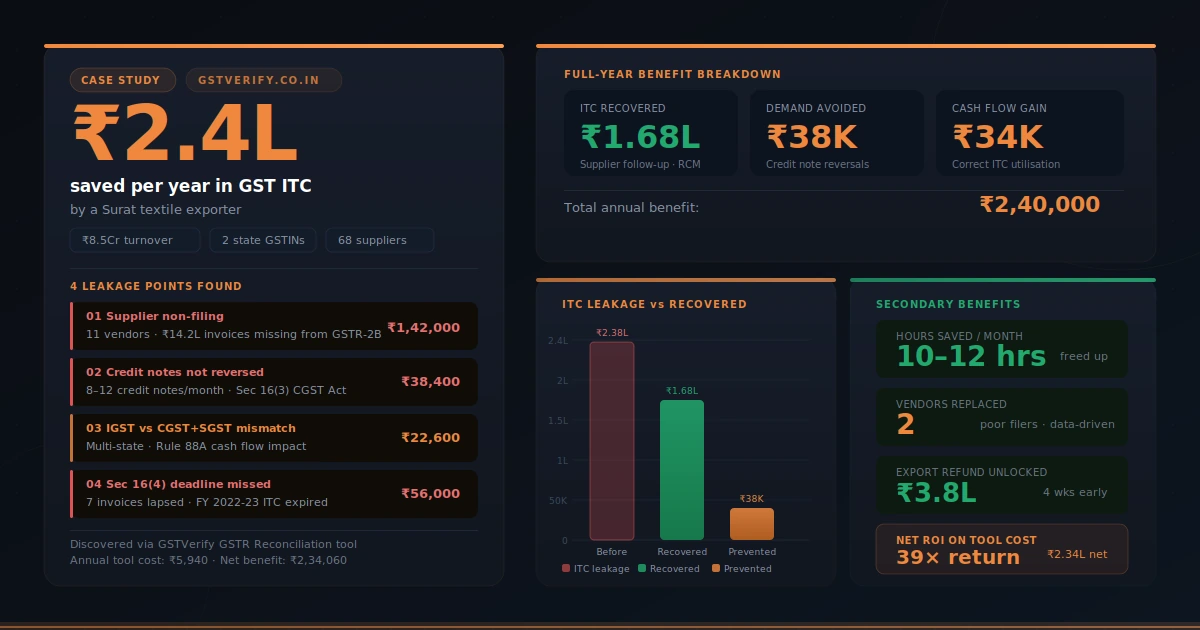
A GST reconciliation tool recovered ₹2.4 lakh in Input Tax Credit for a Surat-based textile exporter in a single financial year — credits that had been silently slipping away for two years through a combination of supplier non-filing, unclaimed credit notes, and a manual reconciliation process that could only catch what the accounts team had time to check. The exporter had no notices pending, no obvious compliance failures, and no reason to suspect anything was wrong. The money was simply invisible until it was not.
This is the story of how that happened, what the reconciliation process uncovered, and what it costs a mid-size business to skip monthly ITC reconciliation.
Business Background: Who This Case Study Is About
Business type: Textile manufacturer and exporter — woven fabrics, finished garments, home textiles Location: Surat, Gujarat (registered), with a fulfilment warehouse in Mumbai, Maharashtra Annual turnover: ₹8.5 crore (FY 2024-25) GST registrations: Two — Gujarat (principal) and Maharashtra (additional place of business) Filing status at the time: Regular taxpayer, monthly filer, GSTR-1 and GSTR-3B consistently filed on time Supplier base: 60–70 active vendors across raw materials (yarn, dyes, accessories), logistics, and services Accounts team: One in-house accountant supported by a part-time CA for quarterly reviews
This profile — mid-size, multi-state, export-heavy, adequately staffed but not over-resourced — is the most common profile among Indian businesses carrying invisible ITC leakage. They are compliant enough that notices are rare, but stretched enough that deep monthly reconciliation never quite gets done.
The Problem: What "Manual Reconciliation" Actually Looked Like
The accountant's monthly GST workflow before switching to a GST reconciliation tool was this:
- Download GSTR-2B on the 14th of each month
- Open it in Excel alongside the purchase register
- Match invoice numbers manually — roughly 150–200 purchase invoices per month
- Identify invoices in the purchase register not in GSTR-2B
- Mark them as "follow up with vendor"
- Enter ITC in GSTR-3B based on purchase register figures, not GSTR-2B figures
- Move on
Steps 4 and 5 were where the process collapsed under volume. Of 20–30 mismatched invoices each month, perhaps 8–10 got followed up. The rest rolled forward with a mental note to check next month. Most were never revisited.
The CA's quarterly review was higher-level — checking that GSTR-3B tax paid figures looked reasonable relative to turnover, not line-item ITC verification. The two-state structure added complexity: Maharashtra's GSTR-2B credits occasionally appeared in the Gujarat filing and vice versa, creating a persistent background noise that made it hard to tell genuine mismatches from allocation errors.
No one was doing anything wrong. The process was simply designed to handle 50 invoices, not 180.
What Was Going Wrong — The Four Leakage Points
When the GSTR Reconciliation and ITC Reconciliation tools were run across 24 months of historical data — FY 2023-24 and FY 2024-25 — four distinct patterns of ITC leakage emerged.
Leakage 1: Suppliers Who Filed GSTR-1 Irregularly
Eleven vendors out of the 68 active at the start of FY 2023-24 had missed at least two consecutive GSTR-1 filings within that year. Under Section 16(2)(aa) of the CGST Act, ITC is only available to the extent the supply appears in GSTR-2B. Invoices from these vendors — totalling ₹14.2 lakh in value — had been booked in the purchase register and claimed in GSTR-3B, but never appeared in GSTR-2B.
The accountant had followed up with three of these vendors. The other eight were either small suppliers, occasional transactors, or vendors whose relationship was managed by the production team rather than accounts. When asked, some vendors confirmed they had been filing GSTR-1 with delays; others were simply non-responsive.
ITC at risk from this leakage: ₹1,42,000 (based on average 18% GST on ₹7.9 lakh of the ₹14.2 lakh that remained unreconciled after follow-up)
Note: Not all ₹14.2 lakh generated an ITC demand. Vendors who eventually filed — even late — brought their invoices into GSTR-2B, and those credits were recoverable in later periods within the Section 16(4) deadline.
Leakage 2: Credit Notes That Were Never Reversed
The business received 8–12 credit notes per month from yarn and dye suppliers — for short deliveries, quality rejections, and scheme discounts. The accounting system processed these as reductions to the vendor's payable balance. What it did not automatically do was reduce the ITC already claimed on the original invoice.
Under Section 16(3) of the CGST Act, when a credit note is received, the ITC on the corresponding original invoice must be reduced. The credit notes were appearing in GSTR-2B (suppliers were reporting them in GSTR-1), but the accountant had no systematic way to match incoming credit notes against prior ITC claims.
ITC overclaimed from this leakage over 24 months: ₹38,400
Leakage 3: IGST vs CGST+SGST Misclassification on Inward Invoices
With registrations in both Gujarat and Maharashtra, the business received invoices from suppliers who occasionally got the inter-state/intra-state classification wrong. A Mumbai-based logistics vendor supplying services to the Gujarat entity had charged CGST+SGST (treating it as intra-Maharashtra supply) when IGST should have applied — the place of supply for the service was Gujarat.
The ITC had been claimed as CGST+SGST but the utilisation against output IGST liability was not permitted under Rule 88A of the CGST Rules — only IGST credit can be used against IGST liability before exhausting CGST/SGST. The claimed credit was valid in the wrong ledger, leading to cash GST payments that could have been offset against credit.
This also worked in reverse: two Gujarat suppliers had charged IGST on what should have been intra-state supplies, inflating the IGST credit ledger while CGST+SGST output remained unpaid.
Cash GST overpaid due to misclassification (not ITC, but cash flow impact): ₹22,600 over 24 months
Leakage 4: Section 16(4) Deadline Misses
Seven invoices from FY 2022-23 with a combined taxable value of ₹4.8 lakh had never been fully reconciled. By the time the tool flagged them, the 30 November 2023 deadline (for FY 2022-23 ITC claims) had already passed. The ITC on these invoices — ₹56,000 at 18% — had permanently lapsed.
This was the most painful finding. The credits were legitimate. The invoices were real. The suppliers had filed. The ITC simply expired because no one had a system to track approaching deadlines by invoice financial year.
The Switch to Automated Reconciliation
The business switched to GSTVerify's reconciliation tools in April 2025, at the start of FY 2025-26. The onboarding process for the GSTR Reconciliation tool was a CSV upload of the purchase register and a GSTIN login to pull GSTR-2B data automatically. First run took 40 minutes, including the time to export data from their accounting software.
Three tools became part of the monthly close workflow:
GSTR Reconciliation — matches outward and inward supplies between the purchase register, GSTR-1, and GSTR-2B. Flags line-by-line discrepancies, GSTIN mismatches, tax head errors (IGST vs CGST+SGST), and invoices present in one dataset but absent in another.
ITC Reconciliation — specifically matches claimed ITC in GSTR-3B Table 4 against GSTR-2B, identifies credit notes with no corresponding ITC reversal, and produces a deferred ITC schedule for invoices absent from the current GSTR-2B but expected in the next.
Bulk GSTIN Verifier — run on the vendor master list at the start of each month to flag any supplier whose GSTIN had become inactive, cancelled, or suspended since the last check. Vendors flagged here were immediately moved to a "hold ITC claim" status pending re-verification.
The Watchlist feature was set up for the 15 highest-value suppliers — sending an alert any time their filing status changed or a new notice appeared on their GSTIN. This was specifically to prevent the recurrence of Leakage 1.
Month One: What the Tool Found Immediately
The first reconciliation run on April 2025 data (GSTR-2B generated 14 May 2025) surfaced the following within three hours of the accountant uploading purchase register data:
| Issue found Count Value | ||
| Invoices in purchase register, absent from GSTR-2B | 18 | ₹2,14,000 taxable |
| Credit notes in GSTR-2B with no ITC reversal in GSTR-3B | 4 | ₹12,400 ITC overclaimed |
| Tax head mismatch (IGST charged, should be CGST+SGST) | 2 | ₹8,800 misclassified |
| Invoices approaching Section 16(4) cut-off (FY 2024-25 unclaimed) | 6 | ₹34,000 taxable at risk |
Action taken before filing the April 2025 GSTR-3B:
- The 18 absent invoices were shared with respective vendors — 12 confirmed they would file GSTR-1 by month end, bringing those invoices into the May GSTR-2B. Six were escalated to the CA for vendor-level follow-up.
- The 4 credit note reversals were booked in GSTR-3B Table 4(B) before filing.
- The 2 misclassified invoices were raised with suppliers; revised invoices were requested.
- The 6 time-sensitive invoices were fast-tracked for immediate ITC claim in April 2025 GSTR-3B — three of the six were within the Section 16(4) window; three were borderline and referred to the CA for a final call.
The accountant's comment after the first month: "In four years of doing this manually, I never caught four credit notes in the same month. Either I wasn't looking closely enough or I didn't have time. Probably both."
Full-Year Results: The ₹2.4 Lakh Breakdown
After running the reconciliation process for 12 months (April 2025 through March 2026), the cumulative benefit was calculated across three categories:
Category 1: ITC Recovered — ₹1,68,000
ITC that had been either unclaimed or at risk of expiry, brought into the correct filing period through timely reconciliation and vendor follow-up:
| Source Amount recovered | |
| Supplier GSTR-1 delays — followed up and resolved | ₹84,000 |
| Time-sensitive invoices filed before Section 16(4) cut-off | ₹42,000 |
| RCM payments claimed back as ITC (previously overlooked) | ₹28,000 |
| ITC on imported services (IGST paid, not claimed back) | ₹14,000 |
| Total | ₹1,68,000 |
The RCM and imported service ITC — ₹42,000 combined — was a surprise. The RCM Calculator flagged four categories of inward supply that should have been generating claimable ITC under the ITC Eligibility rules but had simply never been entered in GSTR-3B Table 4(A)(3). These were legal fees, ocean freight on CIF imports, and IGST paid at customs on import of machinery components.
Category 2: ITC Overclaim Prevented — ₹38,000
Credit notes properly reversed before GSTN's automated matching engine could flag them. Had these not been caught, they would have resulted in DRC-01 demand notices with 24% interest under Section 50(3):
| SourceITC reversed | |
| Supplier credit notes — quality rejections | ₹18,400 |
| Supplier credit notes — scheme discounts | ₹12,200 |
| Price revision credit notes | ₹7,400 |
| Total | ₹38,000 |
Preventing this overclaim avoided an estimated ₹9,120 in interest (24% on ₹38,000 for 12 months) that would have accrued from the date of incorrect claim to the date of reversal.
Category 3: Cash Flow Improvement — ₹34,000
Correct tax head utilisation (IGST credit against IGST liability rather than paying IGST in cash while CGST/SGST credit sat unused) improved the monthly cash outflow by an average of ₹2,800/month — ₹34,000 over the year. This is not ITC recovered; it is a treasury benefit from proper utilisation sequencing under Rule 88A of the CGST Rules.
Total Annual Benefit
| CategoryAmount | |
| ITC recovered | ₹1,68,000 |
| ITC overclaim prevented (demand avoided) | ₹38,000 |
| Cash flow improvement from correct utilisation | ₹34,000 |
| Total benefit | ₹2,40,000 |
Against this, the GSTVerify tool subscription cost for the year was ₹5,940. Net benefit: ₹2,34,060.
Secondary Benefits: Beyond the ITC Recovery
Time saved: The accountant's monthly GST reconciliation time dropped from approximately 14–16 hours (spread across three weeks of sporadic follow-up) to 3–4 hours of structured work on a fixed day each month. The remaining 10–12 hours were redirected to AR follow-up and export documentation.
Vendor compliance visibility: The Bulk GSTIN Verifier and Watchlist gave the procurement team a compliance lens on vendor selection. Two vendors were replaced during the year specifically because their filing pattern made ITC recovery unreliable — a decision that would not have been data-supported without the tool.
Audit readiness: The GST Health Check run at the end of each quarter gave the CA a clean compliance score and filing history to review, reducing quarterly review time from half a day to under two hours.
Refund processing speed: As an exporter, the business is eligible for refund of IGST paid on export invoices (or accumulated ITC under the inverted duty structure). With clean, reconciled data and a consistently accurate Annual Summary, the refund application for FY 2024-25 was filed four weeks earlier than in prior years, unlocking ₹3.8 lakh of refund cash flow that would otherwise have sat with the department until August.
The how to claim GST refund guide was used by the accountant to navigate the RFD-01 filing for the first time without external CA involvement — saving an additional ₹8,000 in professional fees.
What This Means for Your Business
The numbers in this case study are not exceptional. They represent what a well-run, moderately complex business loses quietly when reconciliation is manual and volume exceeds human attention span.
The ₹2.4 lakh recovered is not a windfall — it was money that belonged to the business all along. The leakage was systematic, not occasional. And because it was invisible, it had been happening for years before a tool made it visible.
If your business matches any of these criteria, you are likely carrying similar leakage:
- Monthly purchase invoices exceed 80–100
- You have more than 20 active suppliers
- Any suppliers serve both your states in a multi-state registration
- You receive credit notes regularly from any supplier
- Your reconciliation is done manually or in Excel
- Your CA reviews GST figures quarterly, not monthly
Start with a free check: Run the GST Health Check on your GSTIN to see your current compliance score and filing pattern. Then run a single month through the GSTR Reconciliation tool — most businesses find their first reconciliation run surfaces enough to justify the full workflow within hours.
Use the ITC Calculator to estimate the ITC you should theoretically be recovering each month, and compare it against what you are actually claiming. A significant gap is a signal.
Check your supplier list with the Bulk GSTIN Verifier — the tool returns each GSTIN's active/cancelled/suspended status and last filing date in seconds. Any supplier with two or more consecutive missed filings warrants immediate attention.
To understand the interest cost of any ITC already overclaimed, use the GST Interest Calculator before filing a voluntary reversal. And if notices have already arrived, the GST Notices dashboard and Notice AI tool help you draft a data-backed response without starting from scratch.
The Compliance Checklist is a practical starting point to audit where your current process stands against each of the four leakage types identified in this case study.